
One of the fastest ways to lose control of ACOS while scaling is mixing experimentation with core spend.1
ASIN Prioritization2
Last year, they hit $250k/mo at a 20% ACoS. Before AiHello, the brand was spending $25k per month on ads for various products. Some did well and others didn’t.
After they met us, they increased their spending to almost $50k a month but $46k of that went to a single ASIN.
This was because the product had the best reviews, the highest CVR, and a much higher search volume than many other ASINs combined.
It also spent 20% to 30% of the budget and generated 80% of total sales.
After our adjustments, the ASIN now does multiple 7 figures in ad sales and organic sales. That’s a lot more than what the total account used to do.
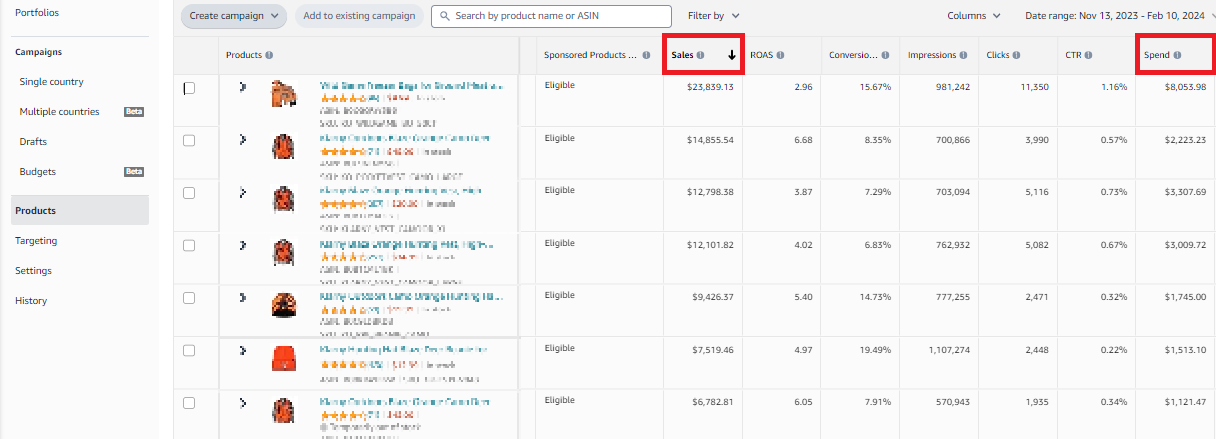
To use this Amazon PPC campaign strategy, start by sorting your ASINs in business reports based on sales volume and identifying the top products that collectively generate 80% of your revenue.
Next, go to “products” in your campaign manager to identify ASINs where total sales contribution is higher than spend contribution.
Separating Core Spend From Experimental Budgets1
- Core spend exists to generate stable, predictable sales. These campaigns are built on proven keywords, ASIN targets, and placements that consistently convert within acceptable ACOS ranges. Their job is execution, not discovery.
- Experimental spend exists to explore uncertainty. New keywords, placements, and formats will naturally have uneven performance. That risk is acceptable only when it’s contained.
Separating the two keeps scaling clean. Core campaigns remain stable and optimized, while experiments run with limited budgets and clear evaluation windows. Failed tests don’t inflate overall ACOS, and successful tests can be promoted deliberately once they prove themselves.
This structure protects profitability while still allowing growth. Decisions are made using clean data instead of blended noise, which becomes increasingly important as spend rises.
Budget Reallocation: Shift to Converting Targets, Cap Experiments3
Bids handle efficiency at the click level, but budgets decide which parts of your account get the oxygen to scale. A common pattern in underperforming accounts is overfunded testing campaigns and underfunded winners, which leads to high ACOS despite some targets being very profitable. A simple fix is to separate spend into “performance” campaigns for proven keywords and “research” campaigns for discovery and testing, then progressively move budget from research to performance as data accumulates.
Start by mapping your campaigns into quadrants based on ACOS and volume:
- high volume / low ACOS (scale),
- low volume / low ACOS (nurture),
- high volume / high ACOS (fix or trim),
- low volume / high ACOS (cut or heavily restrict).
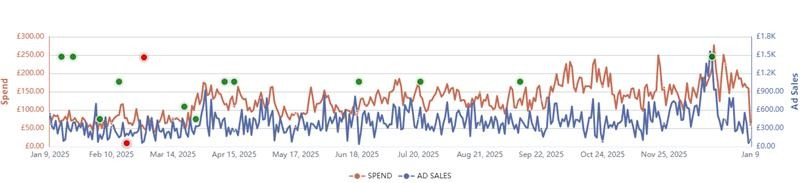
Increase daily budgets on high-volume, low ACOS campaigns so they do not go dark mid-day, and pull budget away from low-volume, high ACOS campaigns that primarily exist to test ideas. For experiments, apply strict budget caps and clear exit criteria, such as shutting off a test if it spends a set amount without a sale or if ACOS stays above a defined threshold across a 14 to 30-day window.
Inventory Checks: The Hidden Scaling Risk1
Nothing disrupts scaled campaigns faster than inventory blindness. Increasing bids and budgets while stock is tight creates a mismatch between demand and supply that advertising cannot fix. As availability drops, CPCs often rise due to unchanged competition, while conversion rates fall because shoppers hesitate when delivery windows stretch or stock appears limited.
The result is wasted spend and rising ACOS, even when targeting remains strong.
At higher spend levels, inventory awareness must be built directly into your scaling logic. Campaign aggression should never be static. It needs to adjust based on real inventory conditions, including available units, sell-through speed, and replenishment timelines. Scaling ads without this alignment doesn’t drive growth, it accelerates inefficiency.