


AiHello
AiHello’s AutoPilot is an automation tool that analyzes your campaigns in real time and makes continuous bid adjustments based on live performance data. It does what a dedicated PPC manager would do but faster, more accurately, and without fatigue.1
Instead of relying on fixed rules or once-a-day changes, AutoPilot reacts hour by hour, optimizing your campaigns for profitability, not just activity.1
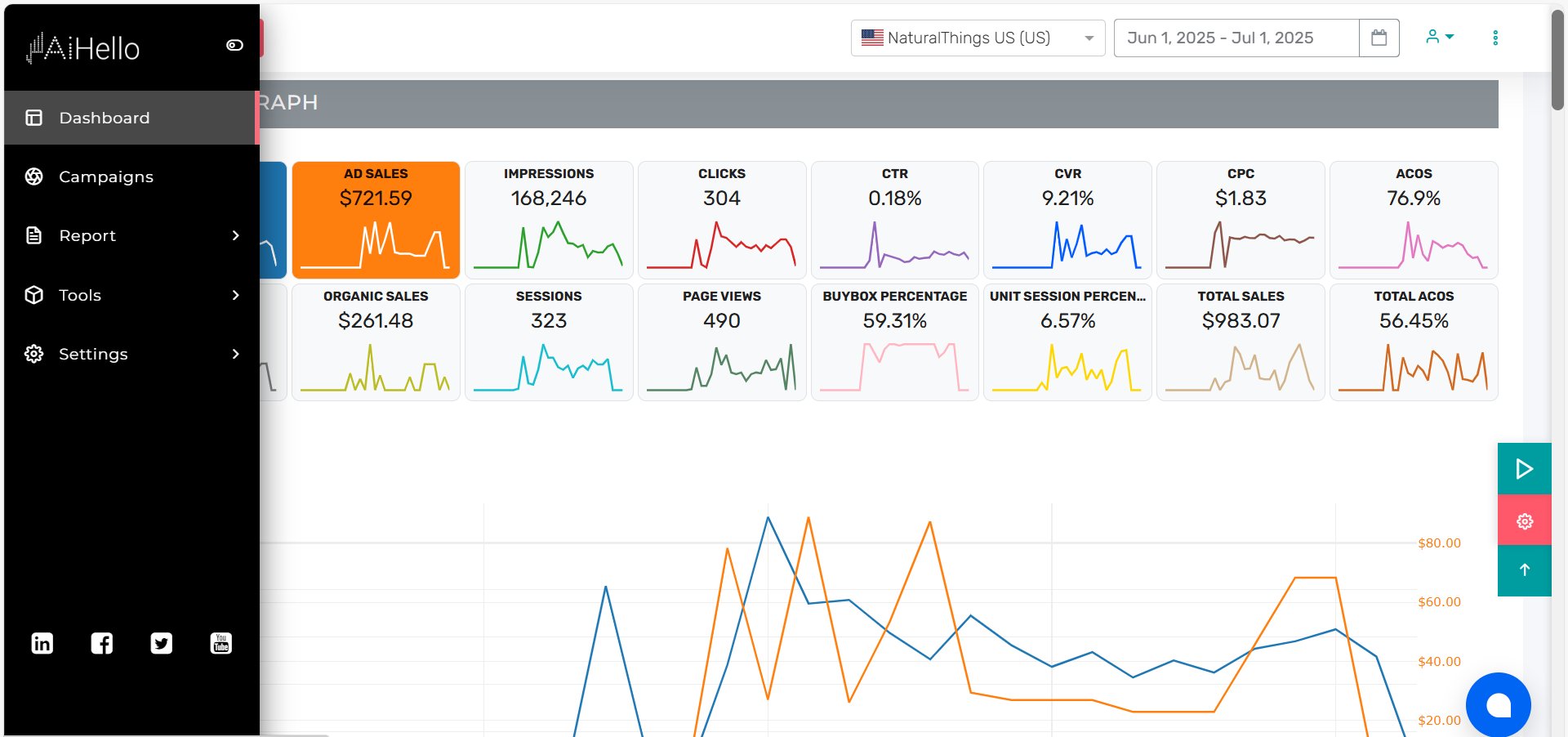
The AutoPilot dashboard gives you a complete overview of how your Amazon ads are performing and more importantly, how they’re being automatically optimized in real time.
This is not just a report, it’s a live control panel that reflects the impact of AiHello’s automation. Every number here tells you a story about your campaigns: where your money is going, which ads are converting, and how your ACoS is being kept in check without manual intervention.
Before your bid enters the Amazon auction, you can choose a bidding strategy that allows Amazon’s algorithm to automatically adjust your base bid based on the likelihood of a conversion.2
Bidding Strategy2
Here’s how the three Amazon bidding strategies work:
Dynamic Bidding (Down Only)
Amazon lowers your bid when a conversion is less likely. It is a great way to minimize wasted ad spend, but it may result in fewer clicks.
Use this strategy if your product has already made a considerable number of sales, and you’re focused on cutting spend on less-converting traffic.
Dynamic Bidding (Up and Down)
Amazon increases your bid when a conversion seems likely and lowers it when it doesn’t. While this can help capture more sales, it might increase your overall CPC.
It’s best for new products or when you’re focused on driving more sales.
Manual Dayparting3
To daypart manually, you can create schedule-based rules, adjust bids via bulk sheets, or pause and unpause your campaigns.
But regardless of the method you choose, you need to know when your ads perform best. This requires tracking your ad spend, ACoS, sales, and CVR via Amazon Marketing Stream.
Collect this data for 7 to 14 days to ensure accuracy.
Your peak periods are hours when you have a higher conversion rate than others or a below-average CPC. These hours will generally have a lower ACoS or higher sales than usual.
Using Schedule-based Rules
To get started, go to the Campaign Manager in your Amazon Ads account.
Here, choose the campaign you want to optimize and head to the “budget rules” section.
Then, set up a schedule-based rule to increase your budget during the high-conversion periods you’ve identified.
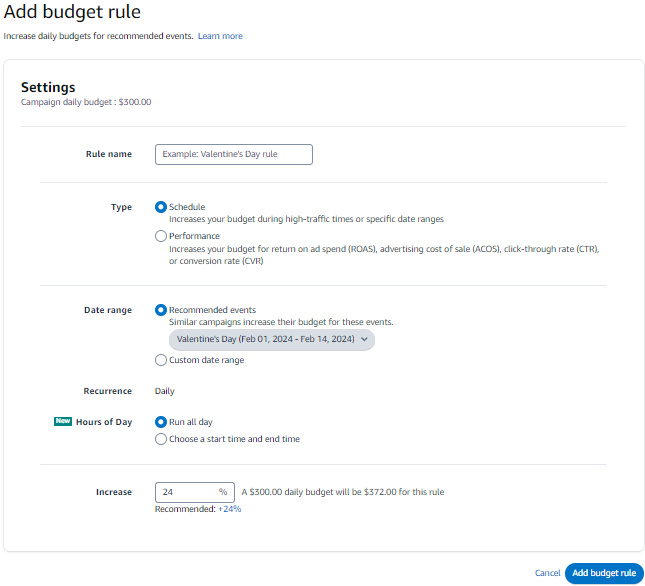
While schedule-based rules allow you to increase your budget during peak hours, you can not automatically reduce your budget during non-peak hours using this method.
Bid Automation (Rules vs. Machine Learning)4
Bid automation adjusts your keyword bids based on historical performance.
- Rules-based: IF ACOS > X, reduce bid by Y%
- ML-based: Learns patterns, predicts converting keywords, and adjusts dynamically
Rules are predictable. ML is adaptive. The best systems usually combine both.
Placement Optimization
Placements (Top of Search, Product Pages) can behave differently from your base bid. Automation can:
- Raise placement boosts when the data shows a strong conversion pattern
- Reduce boosts when costs spike
- Reallocate spend across placements automatically
Keyword Harvesting
Your automation should continuously mine search terms and convert high-performing ones into:
- Exact keywords (for precision)
- Phrase/broad variations (for controlled expansion)
This ensures no valuable keyword slips through.
Negative Keyword Automation
Equally important is cutting waste quickly. Automation eliminates:
- High-spend, zero-sales terms
- Irrelevant search terms
- Low-intent queries that inflate ACOS
Risks & Safeguards4
Automation is powerful, but only when it operates inside the right boundaries. If left unchecked, automated systems can overreact, cutting bids too deeply, increasing them too aggressively, or misreading short-term fluctuations as long-term trends. Seasonal spikes, sudden competition, or temporary conversion dips can all trigger unnecessary adjustments unless proper safeguards are in place.