

AiHello
AiHello is an advanced AI-based automation software that offers Amazon sellers a complete campaign builder, keyword management tool, and dedicated account manager. It lets you skip the learning curve and grow your business faster.1
AiHello offers multiple strategies that you can set up in one click.1
Simply select a product, ACoS target, and budget. The tool does the rest, including keyword research, creating multiple campaigns at once, and optimizing your campaigns to the product and keyword level.
Manual bid changes and basic rules can help when the spend is small, but they quickly break down at scale.2
Scale Insights1
Scale Insights helps Amazon sellers save time by automating their PPC campaigns with advanced bid adjustments, bulk campaign creation, and detailed reporting.
But like any other software, Scale Insights has its downsides. This includes limited functionality, meaning sellers need to pay for multiple tools to handle inventory and other key business areas. Some reviews also say it has a steep learning curve and a less user-friendly interface than many Amazon PPC tools.
Why AI based PPC automation is far superior to Rules Based Engine3
Imagine you plan to drive across your country and visit some cool places along the way.
What is the most important technology you would need to have a successful enjoyable cross country trip?
Most people take this for granted, but it’s our GPS. we don’t even need a separate device for it, it’s built into our phones.
Twenty years ago people had to print out their maps, draw the route and and follow it. They had no idea of the traffic or the road closures or any alternative routes or diversions due to changing conditions.
So why I am telling you this?
Because people using rules based system are a lot like people downloading their maps and planning their journey rather than let an automated GPS show you the way.
In this blog post I am going to walk you over some ways that Rules based PPC system is destroying your PPC game.
Death Spiral
Of all the worst things that could happen when you use a rule based system this one stands out as the worst. So what’s the death spiral?
Imagine that in the rule based system, you set your bid to lower when the ACOS is higher than target.
Competitor changes
The most overlooked aspect for the AI vs rule based systems is that rule based systems do not consider competitor landscape. Competitors are ever changing & dynamic. Their bids ultimately affect your acos because ads are an auction based system. Having fixed rules means that you are fixed and rigid in a ever changing dynamic sea of ads auctions.
Historical performance
How do you handle historical performance in rules based engines?
That was a trick question. The answer is, you don’t.
Rules based systems cannot handle the fact that your current poor performing keyword was a star performance one month ago. It doesn’t need as harsh treatment as other genuinely poor performing keywords.
Sometimes its just a rough patch for the keyword.
Automate Bid Decreases/Increases: Rules vs Machine Learning; Aggression Settings; Floors/Ceilings2
AiHello AutoPilot takes your target ACOS and automatically raises bids on keywords and targets that sit comfortably below that goal, while cutting bids where ACOS drifts too high, so performance gravitates around your target without constant human supervision. Bid aggression controls how fast AutoPilot moves from the current bid to the AI-suggested bid: higher aggression means faster jumps toward the suggestion, useful when ACOS is far from the target, while lower aggression keeps adjustments gradual when you want stability.
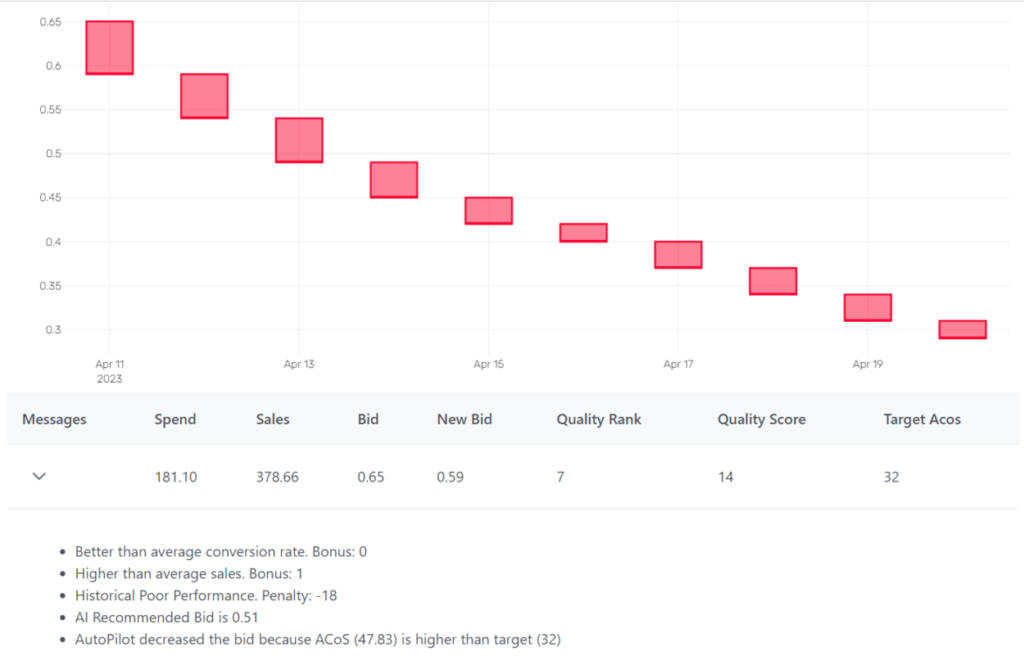
Velocity settings then determine the size of each move, so a bid might go from 1.00 to 1.75 in one step with high velocity or creep from 1.00 to 1.25 with low velocity.